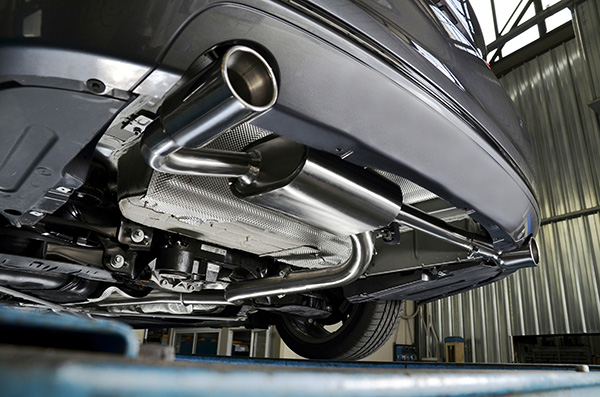
A metallic rattle that only appears at certain engine speeds can be annoying because it may disappear as soon as you try to listen for it. The car can sound perfectly normal at idle, then buzz or chatter around 1,500 or 2,500 RPM before going quiet again.
That pattern usually means something in or around the exhaust system is reacting to a specific vibration frequency. Loose heat shields are common, but exhaust hangers, internal muffler parts, catalytic converters, clamps, and even engine movement can create the same kind of noise.
Loose Heat Shields Often Rattle in a Narrow RPM Range
Heat shields are thin pieces of metal installed around exhaust components to protect the floor, fuel system, wiring, and nearby parts from heat. Because they are lightweight, even a small amount of looseness can make them noisy.
A mounting hole can rust around a bolt, a fastener can loosen, or the shield itself can crack. At one engine speed, the vibration reaches just the right frequency, and the shield starts buzzing. Raise or lower the RPM slightly, and the noise may stop completely. That is why these rattles can seem so inconsistent.
Exhaust Hangers Can Let the Pipes Touch the Body
The exhaust system is supported by rubber isolators and metal hangers that allow controlled movement. Those rubber pieces also keep engine and exhaust vibration from being transferred directly into the body.
If a hanger stretches, tears, or pulls away from its bracket, the exhaust can sit slightly lower or move farther than it should. During acceleration or at a certain RPM, a pipe may touch a crossmember, heat shield, suspension component, or the vehicle's underside. During an inspection, we look for shiny contact marks because they often show exactly where the rattle is coming from.
Clamps and Flanges Can Loosen or Corrode
Exhaust sections are joined with clamps, flanges, bolts, gaskets, and welded connections. Years of heat cycles, road spray, and corrosion can weaken those joints.
A connection does not have to be completely broken to make noise. A loose clamp can vibrate against the pipe, and a rusted flange can move just enough to produce a metallic chatter. If the joint also begins leaking, you may hear a ticking or puffing sound that gets louder when you accelerate.
The Muffler Can Break Internally
A muffler can look perfectly solid from the outside while something has broken loose inside. Internal baffles and tubes face constant vibration, exhaust heat, and condensation.
If a baffle separates, it can rattle inside the shell at one particular RPM. Tapping the muffler or changing engine speed while the vehicle is safely stationary can sometimes help reveal the source. Once an internal piece has broken loose, replacing the affected muffler section is usually more practical than opening and repairing it.
A Catalytic Converter Can Develop an Internal Rattle
The catalytic converter contains a carefully supported internal substrate that exhaust gases pass through. If that material cracks or breaks apart, pieces can move inside the housing and create a metallic rattle.
A damaged converter may also create other symptoms:
- Loss of engine power
- Check engine light
- Sulfur-like exhaust odor
- Excessive heat under the vehicle
- Rattle strongest during acceleration
- Noise from directly beneath the front seats or engine area
We do not replace a converter simply because it rattles. If it has failed internally, we also want to know whether misfires, oil burning, coolant contamination, or an overly rich fuel mixture contributed to the damage.
Engine and Transmission Mounts Can Change Exhaust Position
Sometimes the exhaust is not loose at all. Instead, a worn engine or transmission mount allows the drivetrain to move farther than normal as torque changes.
That extra movement can pull or push the exhaust against another component only at certain RPMs or during acceleration. At our shop, we check mount movement when the noise appears under load but is difficult to reproduce while the car is sitting still. Replacing an exhaust part would not solve a rattle caused by excessive drivetrain movement.
Rust Can Turn a Small Problem Into a Larger Repair
Exhaust components live underneath the vehicle where they see water, road dirt, and constant heating and cooling. Rust tends to attack thin brackets, flange edges, fasteners, and heat shield mounting points first.
Once enough metal is lost, pieces that were originally rigid begin to move. A small buzz can eventually become a broken hanger, separated flange, or exhaust leak. Regular maintenance gives us opportunities to catch loose shields and deteriorating hardware before the surrounding metal becomes too weak to repair cleanly.
The RPM Where the Noise Happens Is Useful Information
If the rattle appears at almost exactly the same engine speed every time, make a note of it. Knowing whether it happens at 1,800 RPM, only under acceleration, only when cold, or only after the exhaust heats up can save time.
A noise tied closely to engine RPM points us toward vibration-sensitive parts. A noise tied more closely to bumps or vehicle speed can lead us toward hangers, suspension contact, or another underbody component. Reproducing the sound under the same conditions is often the fastest way to find the source.
Get Exhaust Repair In New Orleans, LA, With NOLA Automotive Repairs
If your exhaust develops a metallic rattle or buzz at certain RPMs, NOLA Automotive Repairs in New Orleans, LA, can check the heat shields, hangers, clamps, flanges, muffler, catalytic converter, and drivetrain movement.
Schedule an exhaust system check before a small rattle turns into a broken bracket, exhaust leak, or loose section underneath the vehicle.